

Summary
✔ Why Drinking Liters of Milk Won’t Help You Gain Weight Safely: Why increasing regular milk intake often leads to gastrointestinal distress rather than healthy weight gain.
✔ Nutrient Density: Comparing the micronutrient fortification of MalRich against unfortified, standard dairy.
✔ Bioavailability: How clinical formulation enhances nutrient absorption and metabolic efficiency.
✔ Cost-Benefit of Consistency: Why specialized nutrition is a more sustainable long-term strategy for mass gain.
✔ Compliance: Overcoming the “fullness factor” that prevents many adults from hitting their calorie targets.

Introduction
In the pursuit of healthy weight gain, a common question arises: “Why should I purchase a specialized supplement like MalRich when I can simply drink more regular milk?” It is a logical question rooted in the desire for cost-efficiency and simplicity. However, from a clinical nutrition perspective, there is a fundamental difference between “consuming more calories” and “achieving structured nutritional support.” While regular milk is a valuable source of calcium and protein, it is not inherently designed for the high-demand physiological state of a person actively struggling to gain weight.
This guide provides a detailed clinical comparison between ordinary milk and a balanced supplement like MalRich, exploring why specialized formulations often serve as a more effective, efficient, and sustainable tool for body mass development.
The Physiology of Weight Gain: Calorie vs. Nutrient Density
Weight gain is governed by the energy balance equation: Energy In vs. Energy Out. To gain weight, one must create a consistent calorie surplus. However, the quality of that surplus determines whether the body builds muscle or accumulates adipose tissue (fat).
1. The Limitation of Volumetric Intake (Regular Milk)
To achieve a surplus of 500–800 calories using only regular whole milk, an adult would need to consume a significantly large volume of liquid—often upwards of 1 to 1.5 liters daily, on top of normal meals.
- The “Fullness” Barrier: Regular milk is high in liquid volume but moderate in caloric density. Consuming large quantities often leads to early satiety (feeling full) and significant bloating due to lactose content, which inhibits the ability to consume other necessary meals.
- The Caloric Ceiling: Once the stomach reaches its capacity, further intake becomes physically uncomfortable, leading to poor compliance and inconsistent nutrition.
2. The Efficiency of Clinical Fortification (MalRich)
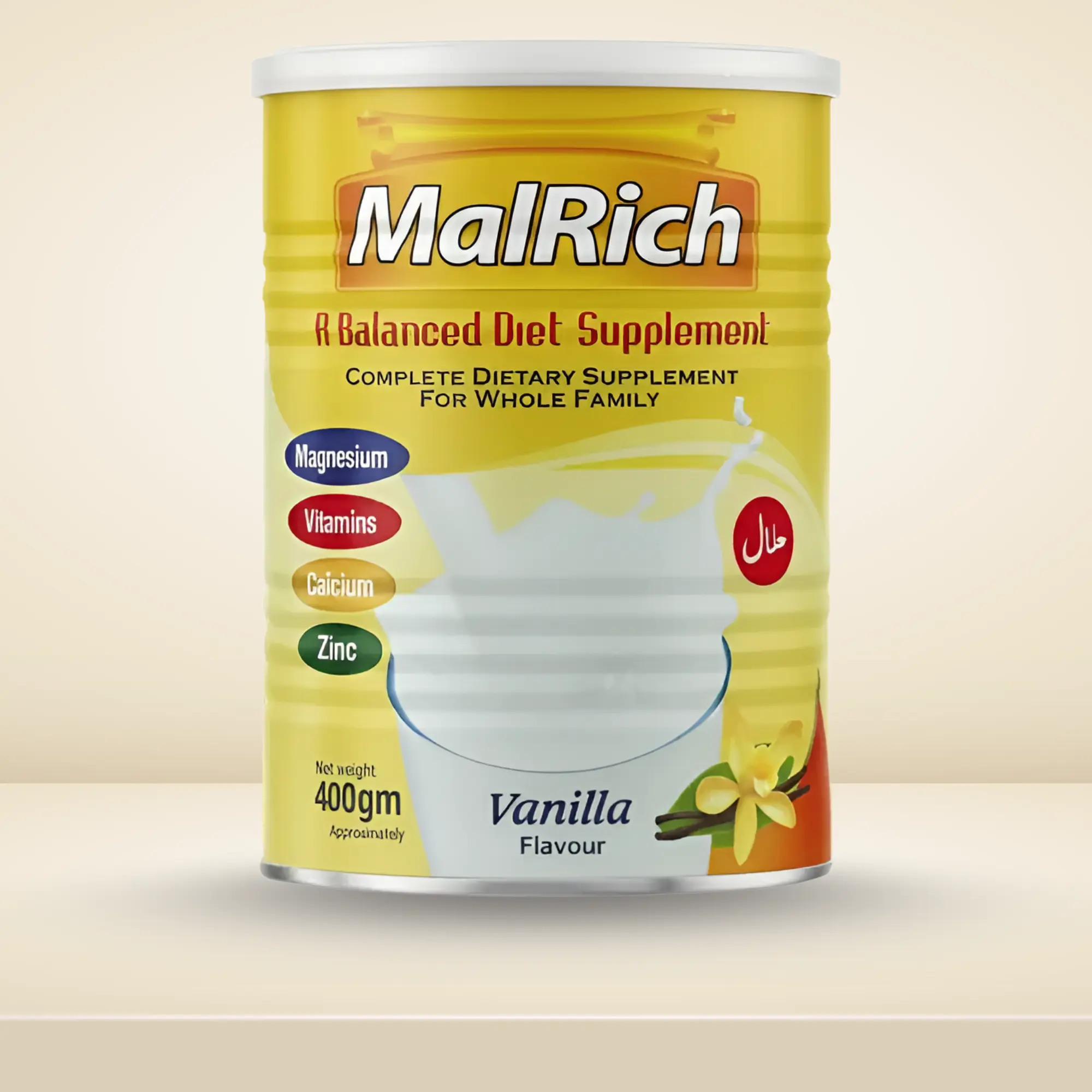
MalRich is engineered to provide a higher “Caloric-to-Volume” ratio. By concentrating macronutrients and supplementing them with essential micronutrients, MalRich allows the body to ingest the required caloric surplus in a smaller, more manageable volume. This preserves the appetite for whole-food meals, ensuring that the total daily nutrition remains balanced.
Malrich vs. Regular Milk: Nutritional Comparison Table
When comparing a standardized serving of MalRich with an equivalent serving of whole milk, the differences in formulation become clear.
Nutrient
- Protein Quality
- Carbohydrate Type
- Micronutrient Density
- Digestion Support
- Energy Density
Whole Milk (Standard)
- Standard Dairy Protein
- Natural Lactose
- Variable/Baseline
- High Lactose Load
- Moderate
MalRich Balanced
- Optimized, Bioavailable Blend
- Balanced Complex/Simple Mix
- Fortified (Vitamins/Minerals)
- Enhanced Digestive Tolerance
- Concentrated
Why “Fortification” Matters
Standard milk is an excellent foundational food, but it lacks the extra metabolic support required for someone in a “weight gain” phase. MalRich is formulated with specific B-Vitamins, Zinc, and Magnesium. These act as “metabolic catalysts”—they help the body process the increased protein and carbohydrate intake more efficiently, ensuring that energy is directed toward tissue repair rather than just being stored as unused glucose.
Tired of Bloating? Why Malrich is Easier to Digest Than Whole Milk
A major obstacle for adults attempting to gain weight via large quantities of milk is digestive intolerance.
The Lactose Factor:
For a significant percentage of the adult population, consuming 1+ liters of milk daily triggers the production of gas, bloating, and digestive discomfort. This is not just unpleasant; it is counter-productive. If your digestive tract is inflamed or over-burdened, your body’s ability to absorb nutrients decreases, and your appetite naturally suppresses.
MalRich is formulated to minimize this “osmotic load” on the digestive system. By creating a blend that maximizes absorption, it reduces the risk of the gastrointestinal distress often associated with “dirty bulking” (drinking excessive amounts of milk or sugary shakes).
Macro-Nutrient Partitioning
When you drink regular milk, your body receives a fixed ratio of macros. However, weight gain often requires a specific partitioning of nutrients.
- The Protein-to-Carb Ratio: MalRich provides an optimized ratio designed to support protein synthesis (muscle repair) while providing the carbohydrate support necessary to spare muscle tissue from being used as energy.
- Metabolic Efficiency: In regular milk, the carbohydrate (lactose) is simple. In MalRich, the carbohydrate profile is adjusted to provide both immediate energy and sustained release, helping to manage insulin levels more effectively—a key factor in healthy, lean tissue gain.
Why Malrich is a More Practical Choice for Busy Adults
In clinical weight management, compliance is the single greatest predictor of success. If a protocol is difficult to follow, it will eventually be abandoned.
- The “Milk Carrier” Problem: Drinking 3–4 glasses of milk throughout the day requires refrigeration, storage, and constant preparation. It is difficult to maintain this routine while at work, traveling, or attending to a busy schedule.
- The “MalRich” Solution: As a powdered supplement, it is shelf-stable, portable, and requires minimal preparation time. This allows for consistent intake regardless of your environment. Being able to take your “Caloric Surplus” in a single, quick shake significantly increases the likelihood of meeting your daily targets.
Debunking the “Artificial” Myth
A common misconception is that because MalRich is a “supplement,” it is artificial or synthetic compared to “natural” milk.
The Reality of Clinical Nutrition:
MalRich utilizes food-based ingredients that are processed to meet clinical standards of purity and density. It is not an alternative to food; it is a tool to bridge the gap between what you can eat and what you need to eat to achieve your physiological goals.
Think of it as “Precision Nutrition.” Just as a carpenter uses a specific type of high-strength glue rather than generic adhesive, MalRich provides the body with the specific nutritional concentrations required for the “construction” phase of weight gain.
Reported User Experiences
The shift from relying solely on natural dairy to incorporating a specialized supplement has been a turning point for many of our users.
Hamza Ali — Islamabad
⭐⭐⭐⭐⭐
“I used to drink liters of milk every day. It just made me tired and bloated. Since switching to MalRich, I get the same caloric surplus in one small glass. My energy levels are stable, and the weight gain is finally happening.”
Mariam Ahmed — Faisalabad
⭐⭐⭐⭐⭐
“I couldn’t eat enough because of the milk volume. MalRich is easy to mix into smoothies. It fits perfectly into my day without making me feel full for hours.”
Evidence-Aligned Supplement Options
The following products illustrate formulation approaches aligned with adult nutritional support.


Frequently Asked Questions (FAQs)
Can I stop drinking milk if I start taking MalRich?
MalRich is designed to be a supplement, not a replacement for a healthy diet. You should still consume whole foods and can continue to consume dairy if you tolerate it well.
Is MalRich more expensive than milk?
If you calculate the cost per gram of protein and micronutrients, MalRich is often more efficient. When you factor in the health benefits of avoiding excessive volume-based bloating, the “cost” of poor digestion makes standard milk a less efficient tool for weight gain.
Why not just use protein powder from the gym?
Many gym supplements are “Protein-Only.” They lack the balanced carbohydrates and micronutrients needed for general weight gain, making them ineffective for someone who is not training like an athlete. MalRich is designed for general adult nutritional support.
How does this impact my metabolic rate?
By providing a consistent, high-quality stream of nutrients, MalRich helps prevent the body from entering a “starvation mode” where metabolism slows down. This supports a healthy weight gain trajectory.
Final Takeaway
While ordinary milk is a beneficial part of a balanced diet, it is often insufficient as a strategy for weight gain. The volumetric requirements to achieve a meaningful caloric surplus through milk alone are physically unsustainable for most adults.
MalRich offers a clinical alternative: precision nutrition. It provides the necessary calories, protein, and micronutrients in a volume that is easy to ingest, digest, and assimilate. If your goal is efficient, sustainable, and healthy weight gain, transitioning from “more volume” to “higher density” is the most professional and effective path forward.
Medical Disclaimer
This article is intended for educational purposes and does not constitute medical advice. Nutritional requirements vary between individuals. Consult with a healthcare professional before making significant changes to your dietary protocol, especially if you have pre-existing digestive or metabolic conditions.
References
- American Journal of Clinical Nutrition: “The Role of Nutrient Density in Caloric Surplus.”
- World Health Organization (WHO): “Guidelines on Food Fortification and Micronutrient Supplementation.”
- ESPEN Guidelines: “Practical Approaches to Oral Nutritional Support in Undernourished Adults.”

Author
Naeem Haider
Licensed Pharmaceutical Professional | Supplement Compliance Specialist
With professional experience in pharmaceutical distribution and supplement regulatory practices, Naeem Haider focuses on promoting safe, responsible, and evidence-aligned use of health supplements. His work emphasizes clinical accuracy, transparent healthcare communication, and informed decision-making to strengthen public confidence.